O-RAN Non-RT RIC
Introduction
A Non-RealTime RIC (RAN Intelligent Controller) is an Orchestration and Automation function described by the O-RAN Alliance for non-real-time intelligent management of RAN (Radio Access Network) functions. The primary goal of the NONRTRIC is to support non-real-time radio resource management, higher layer procedure optimization, policy optimization in RAN, and providing guidance, parameters, policies to achieve higher-level non-real-time objectives. NONRTRIC functions include service and policy management for the near-RealTime RICs. The NONRTRIC implementation communicates with near-RealTime RIC elements in the RAN via the A1 interface. Using the A1 interface the NONRTRIC will facilitate the provision of policies for individual UEs or groups of UEs; monitor and provide basic feedback on policy state from near-RealTime RICs; provide enrichment information as required by near-RealTime RICs
Architecture
The Non-RT RIC is designed as a platform that hosts applications (rApps) which implement control logic for RAN elements. It follows a microservice-based architecture that enables flexibility, scalability, and vendor-neutral deployment.
Note
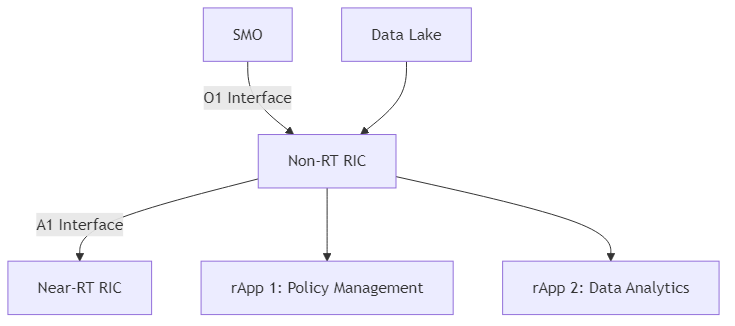
The diagram above shows the key components of the O-RAN Non-RT RIC architecture, including the Service Management and Orchestration (SMO) connected via the O1 interface, the Non-RT RIC itself, rApps that run on the Non-RT RIC platform, and the Near-RT RIC connected via the A1 interface. The Non-RT RIC also interfaces with a Data Lake for storage and retrieval of data.
Key Components
Non-RT RIC Platform: - Policy Framework: Provides the core functionality for policy management, including policy creation, distribution, and enforcement. - Data Analytics Framework: Enables data collection, processing, and analysis for AI/ML-based decision making. - rApp Management: Manages the lifecycle of rApps, including deployment, configuration, and monitoring. - A1 Interface Management: Handles communication with the Near-RT RIC via the A1 interface.
rApps: - Microservice-based applications that implement control logic for RAN elements. - Can be developed by third parties and deployed on the Non-RT RIC platform. - Examples include policy management, data analytics, and ML model training.
Interfaces: - A1 Interface: Connects the Non-RT RIC to the Near-RT RIC. It enables the Non-RT RIC to provide policies and enrichment information to the Near-RT RIC. - O1 Interface: Connects the Non-RT RIC to the Service Management and Orchestration (SMO) for management and configuration. - Data Lake Interface: Enables the Non-RT RIC to store and retrieve data from the Data Lake.
A1 Interface
The A1 interface is a critical component of the O-RAN architecture, connecting the Non-RT RIC to the Near-RT RIC. It enables the Non-RT RIC to provide policies and enrichment information to the Near-RT RIC.
The A1 interface supports several service models:
Policy Management: Enables the Non-RT RIC to define and distribute policies to the Near-RT RIC.
Enrichment Information: Enables the Non-RT RIC to provide additional information to the Near-RT RIC for decision making.
ML Model Management: Enables the Non-RT RIC to distribute ML models to the Near-RT RIC.
rApps
rApps are microservice-based applications that run on the Non-RT RIC platform. They implement control logic for RAN elements and can be developed by third parties. rApps can define policies that are distributed to the Near-RT RIC via the A1 interface, which in turn influence the behavior of xApps running on the Near-RT RIC.
Examples of rApps include:
Policy Management: Defines and manages policies for the RAN.
Data Analytics: Analyzes data from the RAN to identify patterns and trends.
ML Model Training: Trains ML models based on data from the RAN.
Traffic Prediction: Predicts traffic patterns to optimize resource allocation.
Anomaly Detection: Identifies anomalies in the RAN behavior.
rApp Lifecycle
The lifecycle of an rApp includes:
Development: rApps are developed using the SDK provided by the Non-RT RIC platform.
Onboarding: rApps are packaged and onboarded to the Non-RT RIC platform.
Deployment: rApps are deployed on the Non-RT RIC platform.
Configuration: rApps are configured with appropriate parameters.
Execution: rApps run on the Non-RT RIC platform, processing data and making control decisions.
Monitoring: rApps are monitored for performance and health.
Termination: rApps can be terminated when no longer needed.
Implementation Options
There are several open-source implementations of the Non-RT RIC:
O-RAN Software Community (OSC): The OSC provides a reference implementation of the Non-RT RIC, including the RIC platform and several example rApps.
ONF SDRAN: The Open Networking Foundation (ONF) provides an implementation of the Non-RT RIC as part of its Software-Defined RAN (SDRAN) project.
OpenRAN: The Telecom Infra Project (TIP) OpenRAN project includes an implementation of the Non-RT RIC.
Deployment Considerations
When deploying a Non-RT RIC, several factors need to be considered:
Hardware Requirements: The Non-RT RIC requires sufficient compute resources to run the platform and rApps.
Networking: The Non-RT RIC needs to be connected to the Near-RT RIC via the A1 interface and to the SMO via the O1 interface.
Security: The Non-RT RIC needs to be secured to prevent unauthorized access and ensure the integrity of control decisions.
Scalability: The Non-RT RIC needs to be able to scale to support the number of rApps and policies required.
Reliability: The Non-RT RIC needs to be highly available to ensure continuous operation of the RAN.
Conclusion
The Non-RT RIC is a key component of the O-RAN architecture, enabling AI/ML-based intelligence in the RAN. It provides a platform for hosting rApps that implement control logic for RAN elements, enabling optimization of RAN performance and resource utilization. The Non-RT RIC, along with the Near-RT RIC, forms the intelligence layer of the O-RAN architecture, enabling the vision of an open, intelligent, and programmable RAN.
For a step-by-step walkthrough and practical usage, see the Non-RT RIC Experiment in the Sample Experiments section.