Security Testing
Introduction
Purpose: To ensure that the O-RAN system—including all disaggregated components, interfaces, and management layers—maintains confidentiality, integrity, and availability against cyber threats. Security testing validates that every network element (O-DU, O-RU, SMO, Near-RT RIC, O-Cloud, and supporting infrastructure) adheres to O-RAN Alliance security specifications and industry-standard security practices.
Objective: To comprehensively assess whether all O-RAN components, including Open Fronthaul (O-FH), comply with security requirements such as authentication, authorization, encryption, secure transport, and access control. Testing verifies that interfaces are resilient to attacks, securely configured, and enforce proper security controls.
Scope: Security testing covers the entire O-RAN deployment, focusing on:
Authentication mechanisms (e.g., SSH, TLS)
Secure management interfaces (NETCONF, O1 interface)
Encryption and secure transport (DTLS, IPSec)
Integrity protection of O-FH (eCPRI) traffic
Access control on O-DU/O-RU nodes
Vulnerability scanning and configuration checks
Interoperability of security configurations in a multi-vendor setup
While this phase emphasizes O-FH, security tests extend to interworking elements, ensuring that threats are mitigated across all layers of the disaggregated architecture.
Security Considerations for Open Fronthaul (O-FH)
The Open Fronthaul interface (between O-DU and O-RU) is critical, as it carries real-time and near-real-time control/user plane traffic. Security testing for O-FH ensures:
Key Requirements:
Secure Management Plane Configuration: Ensure that SSH/NETCONF access to O-RU and O-DU is authenticated, encrypted, and restricted.
Transport Security: Validate the use of MACsec/IPsec/DTLS where required for protecting non-real-time traffic.
Access Control and Hardening: Verify that only authorized hosts can access O-RU/O-DU management ports.
Protection Against Attack Vectors: Brute-force login attempts, unauthorized configuration access, tampering with fronthaul synchronization messages, replay/injection attacks.
Compliance with O-RAN Security Specifications: O-RAN.WG11.
Applicable Security Test Cases
OTIC security testing aligns with test plans defined by O-RAN Alliance Security WG11 and Test & Integration Focus Group (TIFG). The focus includes:
Authentication validation
Credential and key management
Hardening of management interfaces (SSH, NETCONF, WebUI)
Secure Boot and integrity protection
Logging, monitoring, and audit verification
Vulnerability scanning and configuration assessment
Network Security Protocol - SSH
Objective Verify that the DUT (O-RU or O-DU) only supports SSH algorithms that comply with the O-RAN Security Configuration Guidelines (SCG). This validates SSH Key Exchange (KEX), Host Key, Encryption (Ciphers), and MAC algorithm sets during SSH handshake negotiation.
Goal: - Allowed algorithms are supported - Not allowed algorithms are absent - Optional algorithms behave correctly
Applicability: O-RU / O-DU management plane access; O-FH security compliance; OTIC Security Testing; O-RAN WG11 compliance validation.
Test Environment Setup
The following diagram illustrates a typical setup used for verifying SSH server/client authentication on the O-RAN M-Plane:
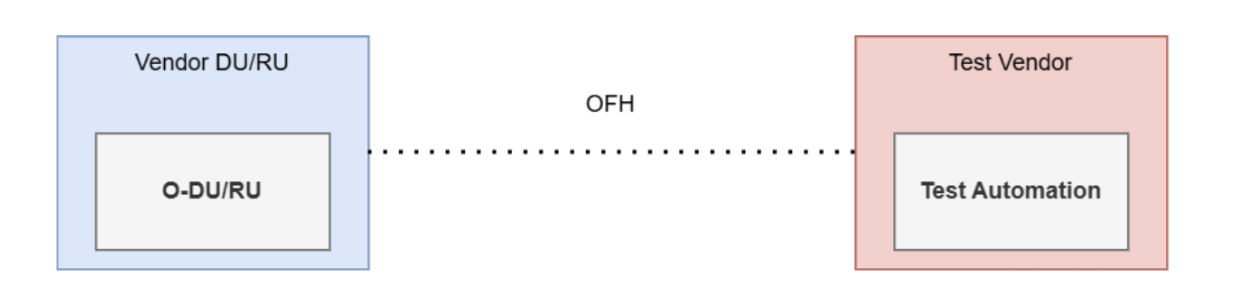
In this scenario, the DUT (O-RU/O-DU acting as SSH server or client) is isolated within a secure VLAN and integrated with the Security Test Controller at the OTIC. The setup allows validation of SSH handshake, authentication (password/cert), and negotiation of cryptographic algorithms.
When testing the SSH Server (e.g., O-RU): The Test Controller acts as the SSH Client (simulating O-DU/SMO) to initiate connections, attempt valid/invalid logins, and verify access controls.
When testing the SSH Client (e.g., O-DU): The Test Controller emulates a malicious or standard SSH Server to verify how the DUT handles server host key verification and connection requests.
Pre-Conditions
DUT reachable on management interface
SSH port enabled
List of algorithms (Allowed / Not Allowed / Optional) from O-RAN SCG available
SSH client capable of printing negotiated algorithms
Test Procedure
Step 1 — Enumerate Supported SSH Algorithms - Use tools to retrieve negotiated algorithm lists. - Record categories: KEX, Host Key, Ciphers, MAC, Compression.
Step 2 — Compare DUT Algorithms Against O-RAN SCG Tables - Match DUT-advertised algorithms to:
Allowed (must appear)
Not Allowed (must not appear)
Optional (may appear but must be secure)
Expected Results
Pass Criteria - Supports all required allowed algorithms - Rejects all not allowed algorithms - Optional algorithms handled per vendor design - Negotiates secure algorithms during normal SSH login - No indication of weak configurations - Logs negotiation failures if mandated by SCG
Fail Criteria - Any not allowed algorithm is supported - Allowed algorithms are missing - Weak SSH algorithms are present or negotiated
Conclusion
Validating the SSH algorithm suite ensures SSH access to O-RU and O-DU follows O-RAN security guidelines on cryptographic strength. This is essential for securing O-FH management interfaces in a multi-vendor deployment.